Meet Your New Shampoo Bar Shower & Travel Case: The Research Behind the Material
We spent years exploring materials and listening to your feedback before we ever landed on a design for our Shampoo Bar 2-in-1 Shower and Travel Cases. One thing became clear along the way: you didn't want two separate products crowding your shower or your suitcase. You wanted something multifunctional, a 2-in-1 solution.
From there, the list of requirements stacked up. It needed to be functional and compact for travel, especially carry-on. It needed to be aesthetically pleasing, something you'd actually want to look at every day. The quality had to meet our standards, and it needed to protect your shampoo and conditioner bars and help extend their longevity. And just as importantly, the material it was made from had to be in line with our values.
A shower and travel case is something you'll hold, use, and eventually let go of - so we wanted to be honest with you about what it's made from, why we chose it, and what happens to it at the end of its life.
This isn't a "greenest possible choice" story. It's a "best available balance, right now, for a small Canadian brand" story. Let's walk through it together.
Three Paths to a Lower-Impact Material
When we started researching materials for our Shampoo Bar 2-in-1 Shower and Travel Cases, there were really three directions we could go:
PLA - a plant-based filament that's industrially compostable, widely available, and accessible in price.
PHA - a bioplastic made by microorganisms, capable of breaking down in far more environments, but currently expensive and hard to source consistently.
Recycled plastic filament - made from reclaimed waste, which keeps material out of landfills, but still behaves like plastic.
Each of these paths reduces impact in a different way, and each comes with real trade-offs. For our case, we chose PLA. Here's the reasoning behind it, and where its limits are.
Why PLA Made Sense for Us, Right Now
PLA (polylactic acid) is made from fermented plant starches, usually corn or sugarcane, rather than fossil fuels. It's become one of the most widely used bioplastics in consumer goods for a reason: it's rigid and holds its shape and dimensions with precision once printed.
For a small, Canadian, small-batch brand like ours, that translated into five practical benefits:
A reliable supply chain:
PLA is produced and distributed at scale, with many manufacturers offering different colours and blends. That reliability matters when you're a small business trying to keep a product consistently in stock, rather than at the mercy of a single niche supplier.
A custom design that adds value:
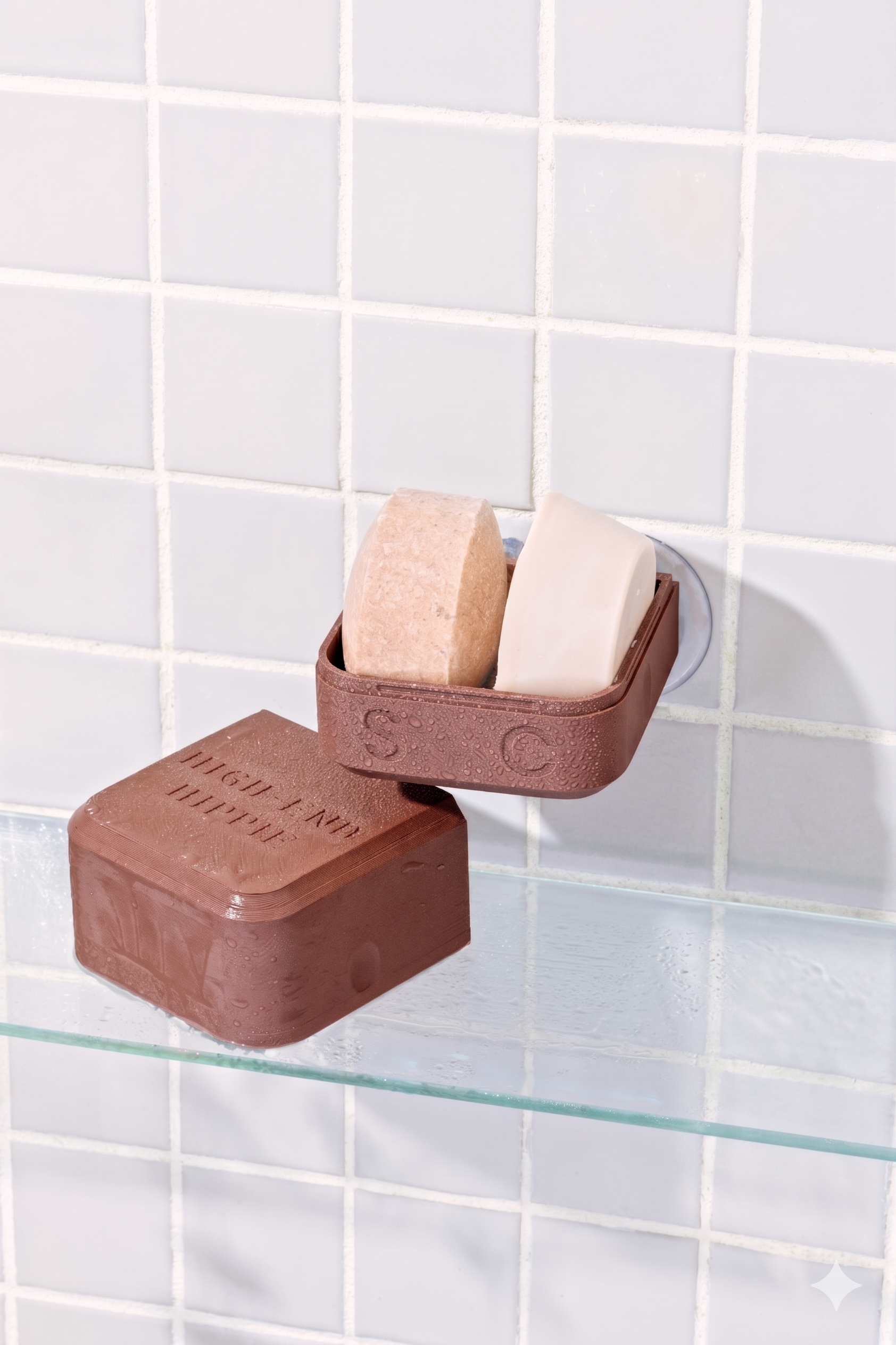
3D printing with PLA allowed us to design a case built specifically to fit our bars, protect them, and help extend their longevity, something you couldn't get from a generic, off-the-shelf container.
Local, small-batch craftsmanship:
Printing locally lets us support small-scale, Canadian manufacturing right here in Kelowna. It also means subtle variations in texture and finish are a natural part of the process, giving every piece its own unique character.
Durable and true to shape:
Compared to many other plastics, PLA tends to warp less and holds its shape well once conditions are right. We've learned firsthand that it still takes attentive, hands-on quality control on our end, since factors like temperature and humidity can affect any given print. In practice, that means we sometimes slow down our manufacturing process and print smaller batches at a time, but that care is part of what lets us keep waste low in our small-batch production.
A price that keeps the case accessible:
PHA, by comparison, often costs three to five times more than PLA, largely because its production capacity is still limited. Choosing PHA today would have meant pushing this case into a much higher price range.
The Honest Pros and Cons of PLA
We believe in transparency, and that means never greenwashing or misleading you. Here's the full picture, pros and limitations included.
What we love about PLA:
Its carbon comes from renewable plant sources rather than fossil fuels.
Under true industrial composting conditions, it can fully break down into carbon dioxide, water, and biomass, without leaving micro or nano plastics behind.
It's easy to print with precision, which means better quality control and less waste in our production.
Where PLA has real limits:
It is not reliably backyard compostable. Standard PLA needs sustained high heat, moisture, and active microbial activity, conditions your backyard compost bin almost never maintains over time.
Similar to traditional plastic, if a PLA item is littered or left to weather in the environment, it can fragment into what is considered to be a microplastic (1 µm to 5 mm) before it ever gets the chance to fully break down.
Like any material, it has a mechanical profile with its own strengths and limits, which is something we accounted for in how we designed this case for everyday shower and travel use.
We're not going to tell you PLA disappears the moment it's done being useful. It doesn't. That's exactly why we care about where your case ends up when its life with you is complete.
Why Not PHA? (Not Yet, Anyway)
PHA is exciting. Made by microorganisms through fermentation, it's designed to fit into natural carbon cycles from the outset, and it can biodegrade across a much wider range of environments, including soil, marine settings, and even home compost.
We love where PHA is heading. It's one of the few materials that can break down outside of an industrial facility. But right now, it's harder to source consistently, and it typically costs three to five times more than PLA. For a small manufacturer producing custom, small-batch cases, that would mean a much higher price tag and a far less stable supply chain.
We chose PLA so we could offer an eco-conscious product that's within reach for more people today. As PHA becomes more available to source, it's absolutely a material we'll keep watching for future versions of this case.
What About Recycled Plastic?
Recycled filament has real upside: it generally uses less energy and produces lower emissions than manufacturing virgin plastic, and it keeps existing waste out of landfills and oceans.
But recycling doesn't change what the material fundamentally is: at the end of the day, recycled ABS and PET are still plastic, and will always shed into microplastics under sun, heat, and wear, just like their virgin counterparts. Recycled filament also tends to be less consistent in quality, which can mean more failed prints and more wasted material without tight quality control.
In our own testing, we ran into this firsthand: cases printed in recycled plastic expanded in the heat of the shower, and the lids became too tight to open, making it impossible to get the bar out of the case, which became a deal breaker for us.
It's a strong option for closing the loop on existing waste. It just wasn't the best fit for a consistent, high-finish product like this case, where we don't control the entire recycling stream ourselves.
Being Real About How PLA Breaks Down
Here's the transparency piece we think matters most.
PLA's end of life happens in two stages. First, over time and under UV light, heat, or mechanical stress, it can fragment into smaller pieces, similar to how conventional plastics behave. Being plant-based doesn't exempt it from this.
True biodegradation, where those polymer chains are fully broken down and metabolized by microorganisms into carbon dioxide, water, and biomass, requires specific industrial conditions: sustained temperatures around 55 to 60°C, high moisture, oxygen, and active microbial life, typically maintained for weeks or months. Home compost bins, landfills, and most natural environments simply don't hold those conditions long enough.
Researchers are still learning how PLA interacts with soil and water when it isn't fully broken down through industrial composting. It's exactly why we encourage you to dispose of your case properly at the end of its life.
Giving Your Shampoo Bar Shower and Travel Case a Responsible Ending: Our Kelowna Composting Partnership
This is where we want to make the responsible choice the easy choice.
Because industrial composting requires specific facilities, and BC's organics programs vary quite a bit from city to city, we've built a local solution for our community. Our retail partner Chickpeace Zero Waste Refillery here in Kelowna has access to industrial composting.
When your case has reached the end of its life, you can bring it back to Chickpeace, and they'll help make sure it enters the right industrial compost stream, rather than a landfill or a backyard bin where it won't fully break down.
If you're outside the Okanagan, we'd still encourage you to check with your local refillery or check for the nearest industrial composter near you, since most major cities have one, and to check your local municipality's organics program before assuming PLA is accepted.
Our Bottom Line
We chose PLA because it lets us build a plant-based, reusable, well-made case within reach of the people who want it, without compromising on the values we hold as a small Canadian, sustainability-focused brand. We aren't going to pretend it's perfect. But it's the most honest, available balance we could find today between environmental responsibility, quality, and functionality.
We are always looking for ways to improve and grow. In the meantime, we've built the end-of-life piece into the experience, so your Shampoo Bar Shower and Travel Case doesn't have to become an afterthought once it's done its job.